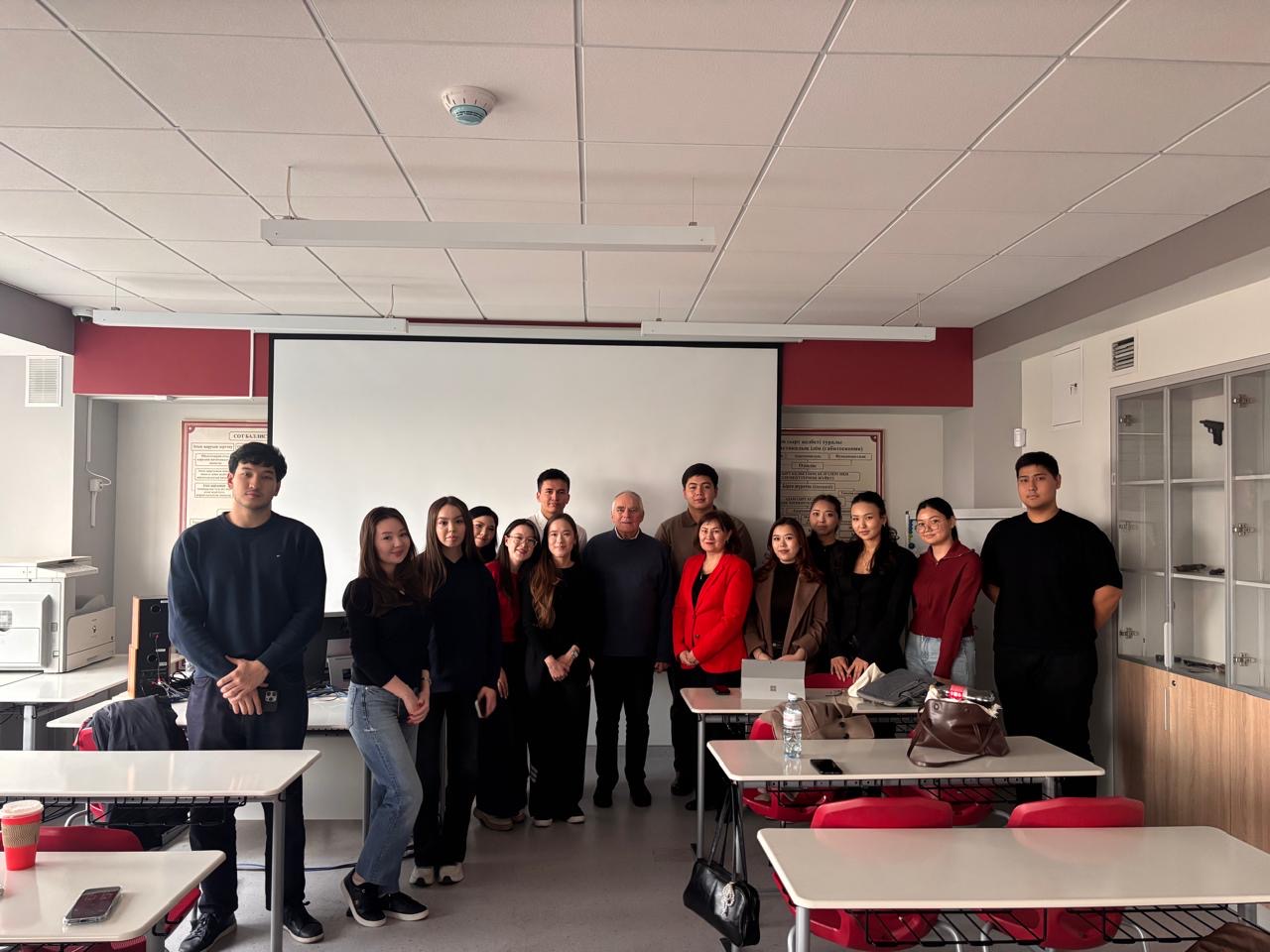
At my invitation, French diplomat Mr Pierre Andrieu visited the School of Law and Public Administration at Narxoz University.
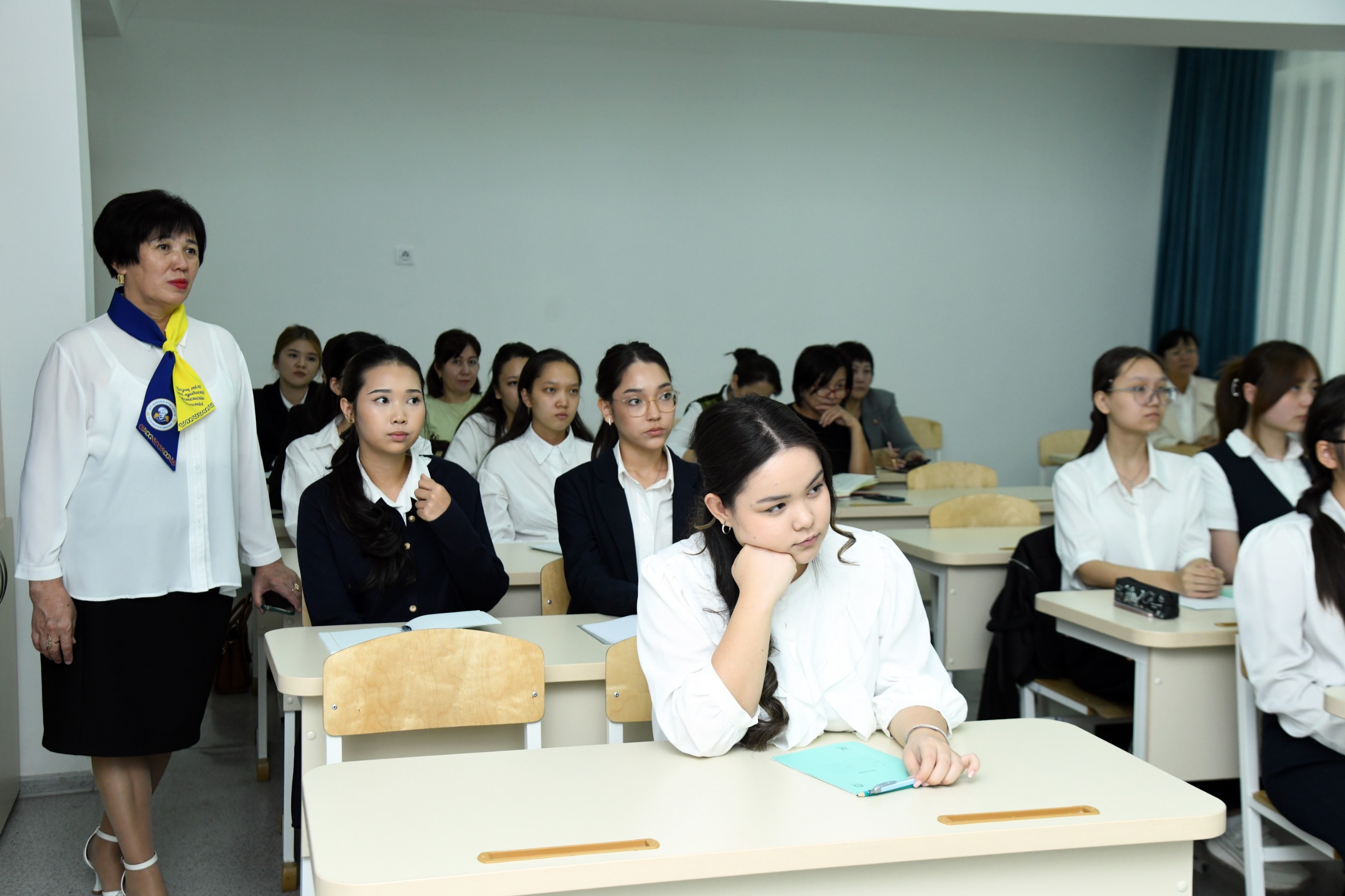
He gave a lecture on “International Relations between China and the European Union” to students of the International Relations degree programme.
Pierre Andrieu is a former French Ambassador to Tajikistan and Moldova and a former Co-Chair of the OSCE Minsk Group. He devoted more than 35 years to the diplomatic service. He has taught at Sciences Po, ISIT and IRIS in Paris, and has lectured at MGIMO University and the Higher School of Economics.
Our acquaintance began two years ago on LinkedIn, while I was working in France. During his visit to Kazakhstan, our wish to meet in person and discuss future plans finally came true.
Hearing first-hand accounts from a seasoned diplomat who served during François Hollande’s presidency further sparked the students’ interest. Mr Andrieu’s command of several languages allowed him to connect easily with the audience and discuss each issue in depth. Real-life case studies combining theory and practice proved truly inspiring for the students.
Nazerke Korynbayeva: “I really enjoyed the lecture by Pierre Andrieu, a French diplomat, former Ambassador of France to Tajikistan and Moldova, and former Co-Chair of the OSCE Minsk Group. What I valued most was that he went beyond theory and shared concrete examples from his diplomatic career, which helped me understand how diplomacy works in practice. His analysis of China–EU relations was also very interesting. As international relations students, we found this meeting especially useful, and it has motivated me to keep growing in my field.”
Sabina Kalykova: “Listening to Pierre Andrieu’s lecture was fascinating. I would especially like to highlight how useful the topic was. It was also very important that, for the first time, we heard French spoken by a native speaker. What stayed with me most was how kind Pierre Andrieu was: he delivered the lecture with great energy and answered our questions in detail.”
Nurbol Saiym: “Pierre Andrieu is one of those figures France can truly be proud of. His family ties to Russia and his fluent Russian made him feel even closer to us. As for his career, he is a truly seasoned diplomat. His involvement in efforts to resolve the Karabakh conflict, his diplomatic service in Russia, and his ambassadorships in Tajikistan and Moldova reflect his extensive experience in international politics. Attending a lecture by a true master of his craft and learning from real cases was an invaluable experience for us.”
“Narxoz University, one of the most prominent in Kazakhstan, along with Professor Almash Seidikenova, did me the great honour of inviting me to speak before their students.
I began by reflecting on my long career at the Quai d’Orsay (the French Ministry for Foreign Affairs), which primarily saw me serve in Moscow, Central Asia and the Caucasus. In that region, I also acted as the French Co-Chair of the Minsk Group, tasked with resolving the Nagorno-Karabakh conflict.
It was during my time as Ambassador to Tajikistan that I first visited Almaty, where I came to appreciate the true worth and greatness of Kazakhstan and its people.
During the lecture, we had an in-depth discussion about the importance of protocol in a diplomat’s work, whose mission is to strictly observe highly precise rules while applying them with a certain degree of flexibility. I gave examples such as President Xi Jinping’s visit to France and the summit organised in Paris in 2014 by French President Hollande in his capacity as Co-Chair of the Minsk Group. On that occasion, the French Head of State welcomed President Aliyev of Azerbaijan and President Sargsyan of Armenia to the Élysée Palace to propose a diplomatic solution to the Nagorno-Karabakh conflict. Beyond the political substance, protocol played a vital role, notably by ensuring that each visiting head of state was accorded the status they deemed appropriate. Ultimately, this Paris summit led to nothing, much like all the other summits organised by the two other co-chairs, the Russian and the American.
Another example I examined in detail was President Xi Jinping’s state visit to France, to Paris and Lyon. Drawing on a video produced by the Protocol Department of the Quai d’Orsay, I gave a precise breakdown of the various stages, covering both the preparation of the visit and its unfolding. The students followed attentively and with great interest, asking many questions.
The discussion then turned to the students’ future plans. All of them expressed a wish to pursue a career in Kazakhstan’s Ministry of Foreign Affairs or in international trade and economic promotion.
All in all, it was an excellent meeting, and the students took a very active part. I am grateful for the invitation to share my thoughts and exchange views.”
Meetings of this kind are of great value to future diplomats. Textbooks present concepts such as “protocol”، “negotiation” and “soft power” as definitions. But when a diplomat who has applied them in daily practice explains them through real events and personalities, these concepts come to life. Moreover, an experienced diplomat can speak candidly not only about successes but also about negotiations that bore no fruit. This teaches students to assess both the possibilities and the limits of diplomacy realistically.
Lectures by ambassadors also help students get a closer look at their future profession, gain the confidence to ask questions in a foreign language and build international connections. Naturally, every diplomat speaks from the standpoint of their own country and personal experience. It is therefore important for students to engage critically with what they hear and to compare different perspectives. The presence of foreign diplomats in university classrooms is a clear example of gaining international experience without leaving the country, in other words, of “internationalization at home”.
Almash Seidikenova,
Candidate of Philological Sciences,
Professor, School of Law and Public Administration, Narxoz University